

Music as a Service (MaaS) vs. Music as a Product (MaaP): Which One are You Building?

Are you chasing a dream or building a business?
It sounds like a trick question, doesn't it? For most musicians, the answer is "both." But if you want to actually make a living, or better yet, a comfortable six-figure career in music, you need to understand exactly which business model you are operating in.
There are two primary ways to make money with a musical instrument. You can build Music as a Product (MaaP) or you can provide Music as a Service (MaaS). Most musicians get these two confused, and that confusion is exactly why so many talented players end up broke and burnt out.
Here at Back On Stage, we spend a lot of time talking about how to turn "gig-seekers" into "Entertainment CEOs." To do that, you first need to identify which side of the fence you're standing on.
What is Music as a Product (MaaP)?
When you think of a "Rockstar," you are thinking of the MaaP model.
Music as a Product is the artist-centric world. You write original songs, you record an album, you put it on Spotify, and you try to sell merch. In this model, the music itself is the product. Your goal is to build a massive fan base that will "consume" what you create.
It is a high-stakes, winner-take-all game. The barrier to entry is low (anyone can upload to DistroKid), but the ceiling is incredibly high. You are competing with every other artist on the planet for a fraction of a cent per stream.
In the MaaP world, you are looking for fans, not clients. You want people to buy into your brand, your story, and your sound. It’s a beautiful, creative pursuit, but as a business model, it is notoriously unreliable for 99% of people who try it.

What is Music as a Service (MaaS)?
Now, let’s talk about the "hidden" industry that actually pays the bills.
Music as a Service (MaaS) is a service-based business model. In this world, you aren't selling "your" music. You are selling a result. That result might be a packed dance floor at a wedding, a sophisticated atmosphere for a corporate gala, or a high-energy vibe at a local festival.
In MaaS, you are serving one client at a time. They hire you to perform a specific function (usually playing popular cover music that people already love). Because you are solving a specific problem for a high-value client, you can charge professional rates.
Think about it this way. A streaming fan pays you $0.003 to listen to your song. A wedding client pays you $6,000 to play "Uptown Funk" and make their mother-in-law dance.
Which one sounds like a more sustainable business?
Why the Distinction Matters for Your Sanity
Most musicians start out with MaaP dreams. They want to tour the world and play their own songs. There is absolutely nothing wrong with that. However, the reality of the 21st-century music industry is that MaaS usually funds the MaaP.
You play the weddings and corporate gigs on the weekends so you can afford to spend your Tuesdays in the studio recording your original EP.
The problem arises when you try to run your MaaS business with a MaaP mindset. If you treat your high-paying wedding band like a "creative collective" where everyone just shows up and jams, you’re going to fail. A service business requires professional band management software, strict systems, and a client-first attitude.

The "Hidden" Industry of the Professional Bandleader
When you embrace the MaaS model, you stop being a "gig-seeker" and start being a business owner.
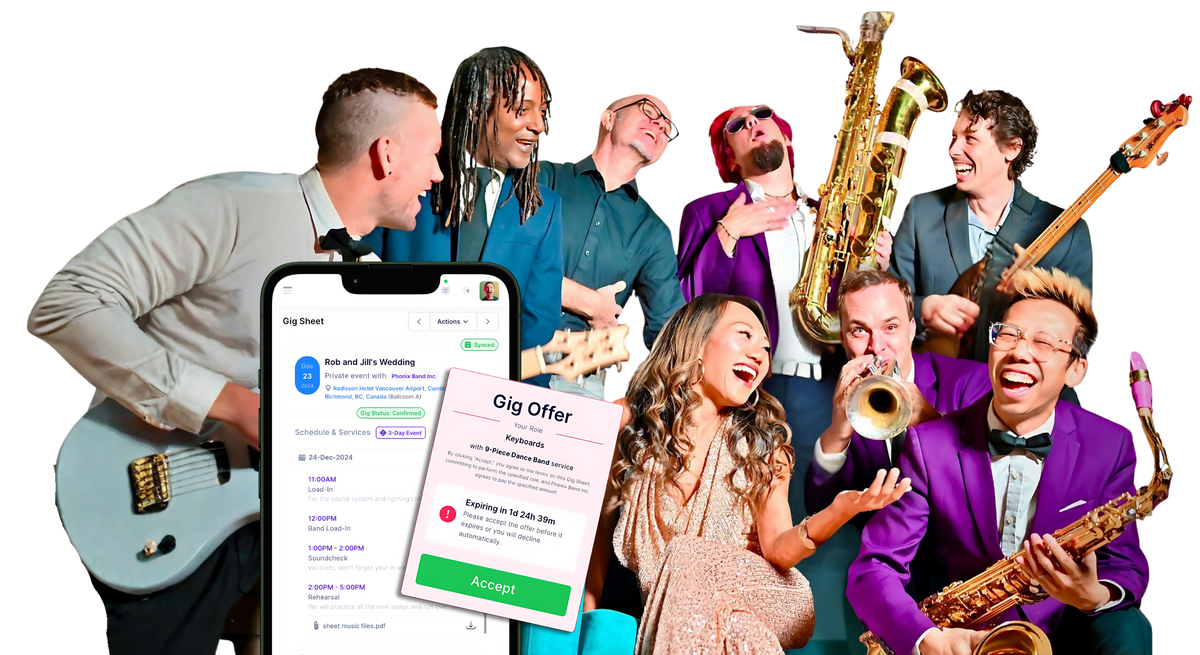
Reuben Avery, the founder of Back On Stage, discovered this firsthand with his own group, The Phonix Band. By treating the band as a service business rather than just a group of guys who played music, he was able to scale from 70 gigs a year to over 380 bookings.
He didn't do this by writing a "hit" song. He did it by building a "hit" system.
When you provide music as a service, your "product" isn't just the notes you play. Your product is:
- How fast you respond to inquiries.
- How professional your contracts and invoices look.
- How organized your communication is with the client.
- How reliably you show up and execute the plan.
This is where most musicians drop the ball. They are great players, but they are terrible administrators. They try to run a $10,000 service business out of a messy group chat and a scattered Google Calendar.
From Gig-Seeker to Entertainment CEO
If you want to dominate the MaaS market in your city, you have to stop thinking like a freelancer and start thinking like a CEO.
An Entertainment CEO knows that their time is too valuable to spend four hours a day chasing musicians for their availability or manually typing out setlists. They use apps for bands to automate the "boring" stuff so they can focus on booking more high-value gigs.
This is exactly why we built Back On Stage. We realized that the MaaS model is incredibly profitable, but only if you can handle the massive admin load that comes with it.

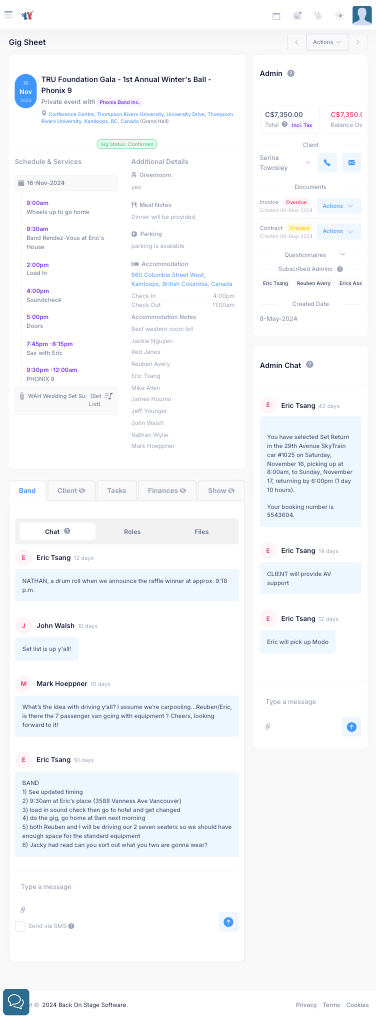
When The Phonix Band scaled to nearly 400 gigs a year, they weren't working 400 times harder. They were using a system that handled the heavy lifting. They used a gig-management dashboard that allowed them to:
- Auto-Book Musicians: No more "Hey, are you free?" texts to 20 different bass players.
- Centralize Communication: Keeping all contracts, invoices, and files in one place.
- Automate Payouts: Ensuring the band gets paid without the leader having to carry a bag of cash.
The Reality Check: Which One Are You?
Take a look at your current calendar.
If your income depends on the number of streams you get or the amount of "clout" you have on Instagram, you are in the MaaP business. You should focus on marketing, branding, and content creation.
If your income depends on booking events, playing covers, or being hired by a client to provide an experience, you are in the MaaS business. You should focus on systems, lead generation, and artist management software.
Many of the most successful bandleaders we know actually do both. They have a "money-maker" band (MaaS) that operates like a well-oiled machine, and they use those profits to fund their "passion project" (MaaP).
The trick is not to let the chaos of the MaaS business bleed into your creative time. If you’re spending all day managing spreadsheets for your wedding band, you’ll never have the energy to write your own songs.
Why You Need a System (Not Just a Calendar)
Whether you’re building a service or a product, you need to save time. But in the MaaS world, time is literally money.
Every hour you spend on admin is an hour you aren't selling your services to a new corporate client or a bride-to-be. If you can save 5 hours per gig by using automation, and you do 50 gigs a year, you just handed yourself 250 hours of your life back.
What could you do with an extra 250 hours? You could record that album. You could spend more time with your family. Or you could book another 50 gigs and double your income.
The MaaS model is the most sustainable way to be a professional musician in the modern age, but it requires a level of professionalism that most "gigging" bands simply don't have. By adopting the right tools, you move past the "starving artist" trope and into the realm of the professional entrepreneur.

Ready to Scale Your MaaS Business?
If you’re tired of the "gig-to-gig" grind and you’re ready to start treating your music like the high-value service it actually is, it’s time to change your toolkit.
Stop relying on generic tools that weren't built for the unique chaos of the music industry. You wouldn't use a hammer to tune a piano, so why use a generic project management tool to run a 10-piece funk band?
Back On Stage was designed by bandleaders, for bandleaders, specifically to handle the MaaS model. We’ve helped bands like The Phonix, Funktastic Productions, and Liquid Blue move from "organized chaos" to "automated profit."
You can start a free trial here and see the difference for yourself. It’s time to stop just "playing gigs" and start building a business that actually supports the life you want to live.
After all, the music sounds a lot better when the bills are already paid.
Ready to see how much time you could be saving? Check out our features page or read more about our story to see how we turned the MaaS model into a science.