
Back On Stage vs. 17hats: Which One Actually Runs Your Band?

The short version
17hats is a general-purpose small-business CRM. It was built for solo service providers and small studios: photographers, coaches, consultants, cleaners. It handles leads, quotes, contracts, invoices, scheduling and workflows, and it handles them competently.
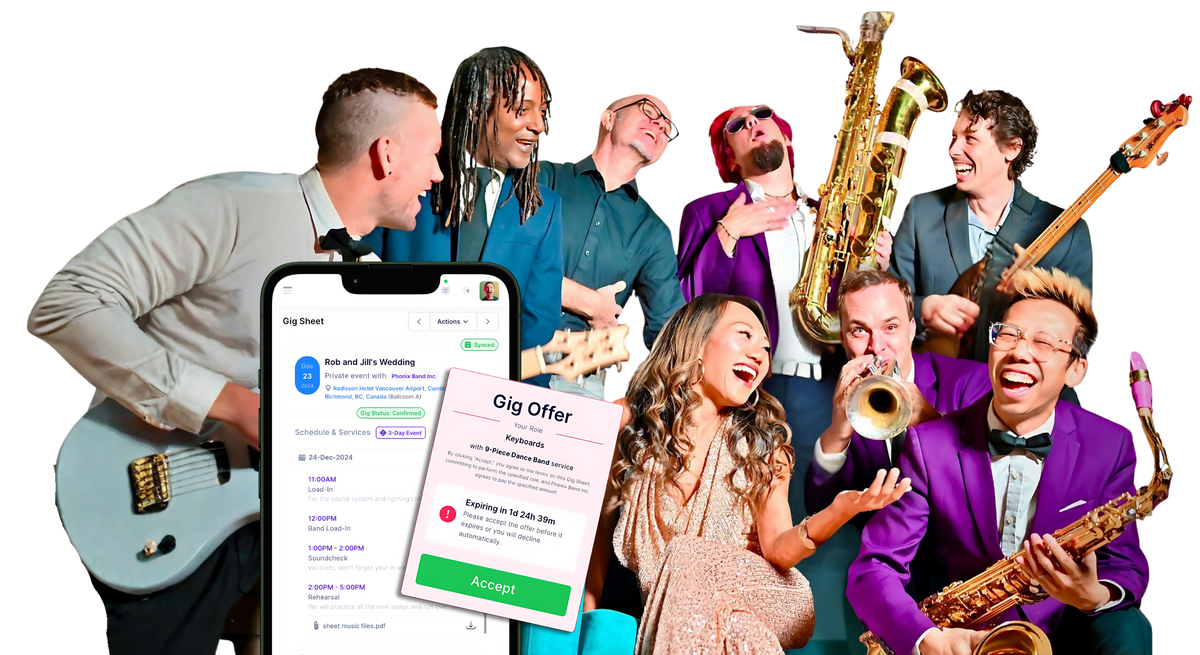
Back On Stage is built for one business: a band. Not a solo operator with clients, but a bandleader with clients and a roster of musicians who have to be offered work, confirmed, given charts, and paid.
That difference is the whole comparison. Everything below follows from it.
Where 17hats is genuinely strong
Worth saying plainly, because a comparison page that pretends the other tool is bad is not useful to anybody.
- Client-side workflow is mature. Lead capture forms, quotes, contracts, invoices, payment reminders and a client portal, all in one flow, refined over years.
- Automation is real. Its workflows genuinely reduce repetitive admin on the client side.
- One price, one plan. As of 2026, 17hats moved from tiered pricing to a single all-inclusive plan at $60/month, with monthly, yearly and bi-yearly billing and a 7-day free trial. There is something honest about not making you decode a feature matrix.
If you are a solo musician — you play, you invoice, nobody else needs paying — 17hats will serve you well and this page is probably not for you.
Where it stops matching how a band works
The moment your gig involves other musicians, a general CRM has no vocabulary for the half of the job that happens after the client says yes.
A booking in 17hats is a client and a job. A booking in a band's real life is a client, a job, and: who gets offered the trumpet chair first, who declines, who the second call is, whether the sub has the right charts, whether anyone is double-booked that Saturday, and how the fee splits across seven people afterwards.
None of that is a criticism of 17hats. It is simply not what it was built to model. But it does mean that if you run a band on it, you get a good client-side system and then you build the entire musician-side system yourself, in a spreadsheet and a group chat, exactly as before.
“I feel like I have a full time secretary and record keeper.”
— Greg Bella, Bella’s Second Shot, a 10-piece Chicago event band running 60+ contractors on Back On Stage
Feature comparison
| Back On Stage | 17hats | |
|---|---|---|
| Lead capture and follow-up automation | Yes | Yes |
| Quotes, contracts, e-signature | Yes | Yes |
| Invoicing and client payments | Yes | Yes |
| Client portal | Yes | Yes |
| Musician roster with per-role rates | Yes | No |
| Automated call order (first call, second call, third call) | Yes | No |
| Double-booking conflict flags across gigs | Yes | No |
| Musician payouts and splits | Yes | No |
| Setlists, charts and sheet music distribution | Yes | No |
| Musician-facing app for the players themselves | Yes | No |
| Multiple acts on one shared talent pool | Yes | No |
| Time tracking | Not a core feature | Yes, $5/mo add-on |
| Bank connection | Not a core feature | Yes, $5/mo add-on |
| Built for industries other than live music | No | Yes |
Rows marked "No" for 17hats mean the feature is not part of its product as publicly documented, not that it works badly. It is a general business CRM; band staffing is outside its scope by design.
The pricing question is really a seat question
17hats is $60/month on its single all-inclusive plan, which covers a small number of users. Time tracking and bank connections are $5/month each on top. Past roughly two team members, per-user costs begin to stack.
That model makes sense for the business it was designed for, where every extra user is another person generating revenue.
It fits a band badly, because most of the people who need access to a band's system are not admins. They are musicians who need to see a gig sheet, accept a call, download a chart and check they got paid. On a per-user model, every one of those people is a line item. That is the single sharpest practical difference: Back On Stage charges for admin seats, and musicians are free and unlimited. A 14-piece band and a 4-piece band cost the same to run.
For reference, Back On Stage is $19/month on Starter, $40/month on Pro and $63/month on Agency, all billed annually, with 1, 3 and 5 admin seats respectively. Musicians and crew are unlimited and free on every plan.
Where 17hats is the better answer
Genuinely, and this matters if you are deciding:
- You run more than one kind of business and only one of them is music. 17hats is industry-agnostic; Back On Stage is not, and will not help you with your photography clients.
- You are a solo performer with no roster to manage.
- You need time tracking and bank-feed reconciliation as first-class features.
Where Back On Stage is the better answer
- You hire other musicians, and offering, confirming and paying them is a real part of your week.
- You run more than one act, or one act in several configurations, off the same pool of players.
- Your musicians ask you things you would rather they could just look up: what time is load-in, what am I playing, did I get paid.
- You want the people cost of the system to scale with the number of admins, not the number of players.
The honest test
Ask yourself what happens in the hour after a client signs.
If the answer is "I send an invoice and put it in the calendar," a general CRM like 17hats is a fine fit and probably a cheaper path to organised.
If the answer involves texting five musicians, checking whether your usual drummer is already out that night, and making a mental note to sort the split later, then the client-side tool was never the missing piece. That work is the job, and it is the part Back On Stage was built for.
Bands on Back On Stage have collected over $25M in real gig income through the platform. Over 10,000 musicians use it, across more than 8,000 booked gigs.
Compare Back On Stage to other tools
- Back On Stage vs. HoneyBook
- Back On Stage vs. Dubsado
- Back On Stage vs. Band Pencil
- Back On Stage vs. My Gigs
- Back On Stage vs. BookLive Pro
- Back On Stage vs. Muzeek
- Back On Stage pricing
Start your 30-day free trial of Back On Stage.
All 17hats pricing and feature details on this page come from its publicly published pricing and product material as of August 2026. Pricing changes; check 17hats directly before making a decision on cost.