

Back On Stage vs. BandMGT: Managing a Band vs. Running a Band Business
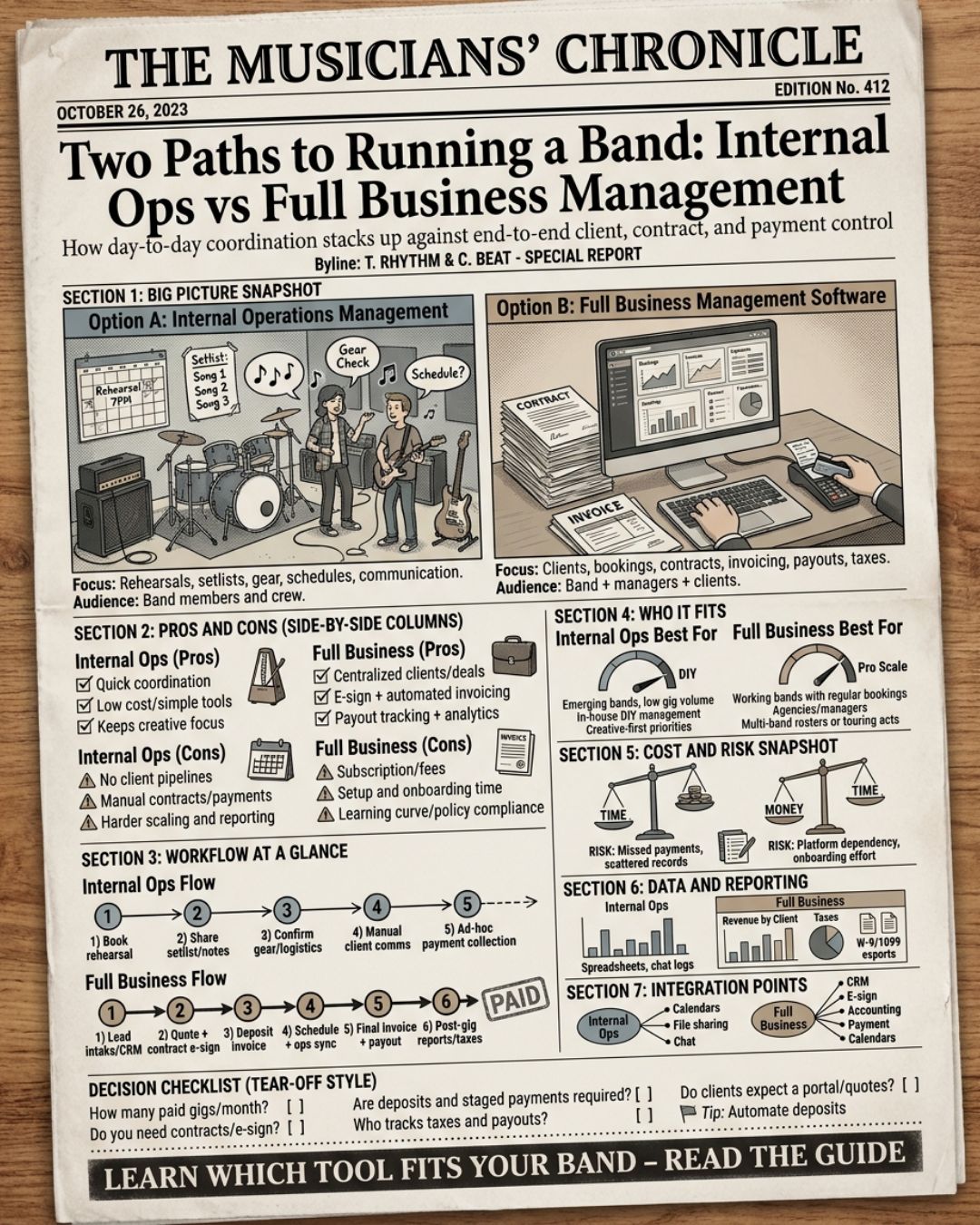
The short version
BandMGT is a good tool, and it is genuinely cheap. If what you need is a shared calendar, drag-and-drop setlists and a running tally of who owes what, it does that well and it starts at zero.
It just solves a different problem than Back On Stage does.
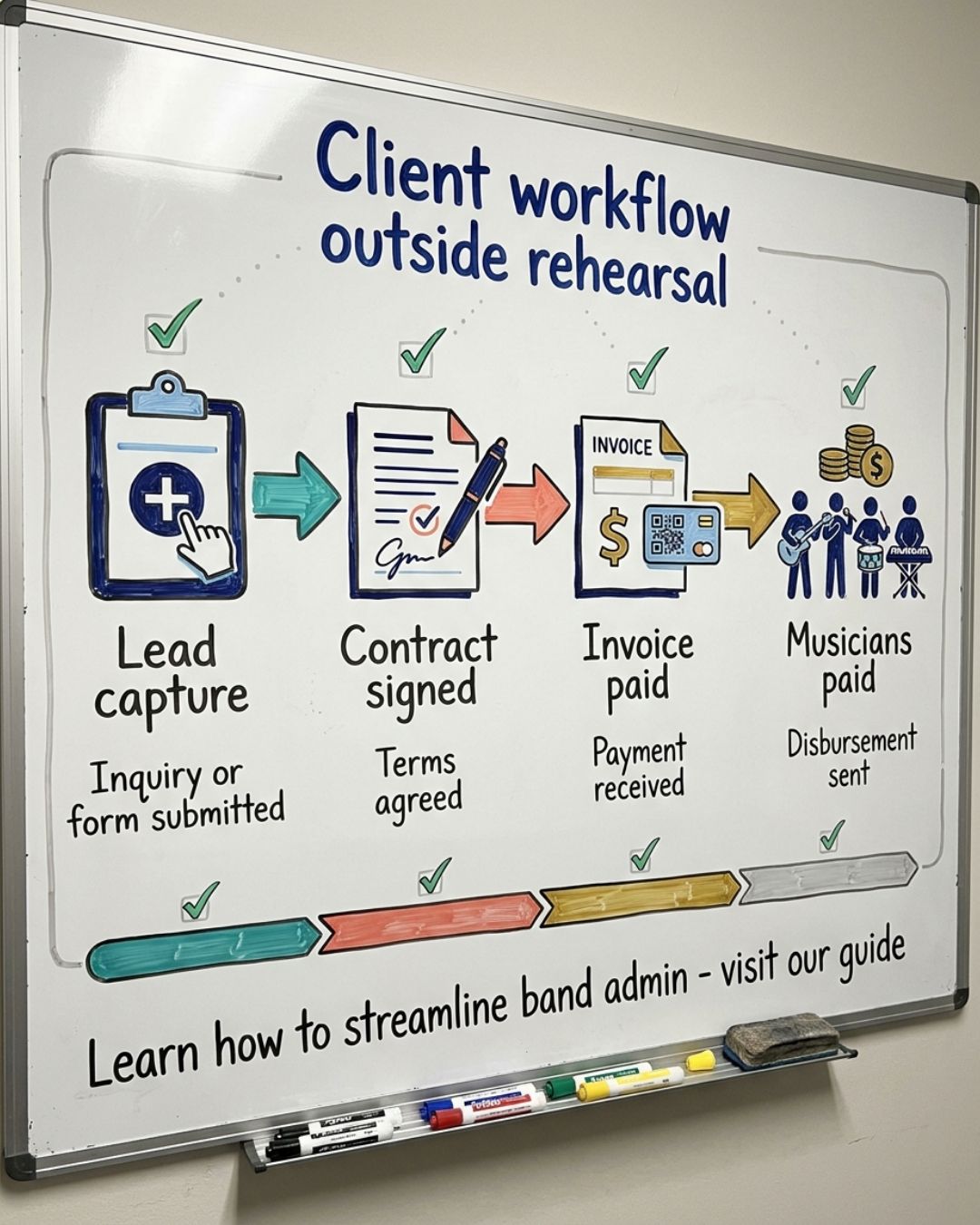
BandMGT organises the band. Back On Stage runs the business. The difference is everything that happens between a client emailing you and the money landing in everyone's account, and that is the part that is neither a calendar nor a setlist.
If you are three people splitting bar gigs, BandMGT may be all you ever need, and we would rather tell you that than sell you something you do not. If you are quoting clients, sending contracts, collecting deposits and paying a rotating roster of musicians, keep reading.
What BandMGT actually does
Taken from their own site, honestly and without spin:
- Smart shared calendar for gigs, rehearsals and meetings
- Blackout management so you can see member availability before you book
- External calendar feeds to sync into any calendar app
- Drag-and-drop setlists with PDF generation
- AI Setlist Coach that rates a set and suggests changes
- Spotify integration and song analytics (BPM, key, genre)
- Venue management with auto-fill venue details, plus AI venue insights on the Pro plan
- Event-based finances (Pro): fees, expense categories and per-member payment tracking
- Performance dashboard showing gig history and year-over-year income
Their pricing is public and simple: a free tier covering scheduling, setlists and song analytics, and BandMGT Pro at $8/month per band for the finance and analytics tools.
That is a fair deal for what it is. The setlist tooling in particular is nicer than most, and the AI song analysis is a genuinely interesting idea.
Where the two tools stop overlapping
Look at that feature list again and notice what is not on it. There is no client anywhere in it.
No lead capture. No client portal. No contracts. No client invoicing. No way for a client to pay you. No automated follow-up on an enquiry. And critically, no way to actually pay your musicians, only to record what they are owed.
That is not an oversight on BandMGT's part. It is a deliberate scope. They built an internal band tool, and they built it for bands whose main problem is that the rehearsal schedule lives in a WhatsApp thread.
Feature comparison
| BandMGT | Back On Stage | |
|---|---|---|
| Shared gig calendar | Yes | Yes |
| Member availability / blackouts | Yes | Yes |
| Setlist builder | Yes, drag and drop, PDF export | Yes, with sheet music assigned per role |
| Song analytics (BPM, key, genre) | Yes, plus AI Setlist Coach | Custom song data, no AI coach |
| Repertoire and chart storage | Setlists and PDFs | Unlimited MP3 and PDF storage, distributed automatically to the right musician |
| Lead capture form for your website | Not listed | Yes, with automated follow-up sequences |
| Client CRM | Not listed | Yes |
| Client portal | Not listed | Yes, branded, where clients review and sign |
| Contracts with e-signature | Not listed | Yes, auto-generated from booking details |
| Client invoicing and online payment | Not listed | Yes, invoices generated from the booking, clients pay online |
| Automated staffing of a gig | Not listed | Auto-Book and Shotgun Book, offers go out until every role is filled |
| Actually paying musicians | Tracks balances only | Auto-Pay sends the payouts, generates each musician's invoice |
| Client questionnaires | Not listed | Yes |
| Task lists with relative due dates | Not listed | Yes |
| Pricing | Free tier; Pro $8/mo per band | See current plans; one subscription covers unlimited members and admins |
Where a row says "not listed," that means the feature does not appear anywhere in BandMGT's public marketing or pricing pages as of August 2026. It is not a claim that the feature is impossible, only that they do not advertise it.
Be honest about the price gap
Back On Stage costs more than $8 a month. A lot more. Pretending otherwise would be insulting.
The honest way to think about it is what each replaces. BandMGT Pro replaces a shared calendar and a finance spreadsheet. Back On Stage replaces a contract tool, an invoicing tool, a payment processor, a CRM, a lead form, a file store and the two evenings a month you spend doing payouts by hand.
Mike Zabrin, who runs Funktastic Productions in Chicago, put the stack problem plainly:
"We were using monday.com, Active Campaign, Dubsado, Google Calendar... paying for a bunch of tools. If you're not really thinking smart... you're gonna have to raise your rate so high that you're cut out of the local competition."
Mike Zabrin, Funktastic Productions
If you are not paying for any of those tools yet, the price gap is real and BandMGT wins on cost. If you are paying for three of them, the comparison changes shape.
The bit that decides it: who is on the other end
Here is the question that sorts these two tools faster than any feature table.
When you open your band software, are you looking for your musicians or your clients?
If the answer is musicians, and the client relationship happens in your inbox, BandMGT covers you and $8 a month is a bargain.
If the answer is clients, and the thing that actually eats your week is quoting, chasing signatures, invoicing, and then sitting up on a Sunday night sending eleven separate payments, then a calendar and a setlist builder are not going to move the needle. That work does not live in the rehearsal room.
Nikki Green, who manages talent for Liquid Blue in San Diego, described exactly that side of it:
"I used to manually check 35 invoices, inputting every single amount into direct deposit. I can't imagine that anymore. It used to take me 3 hours to get everything set and scheduled for a gig. Now it takes me 15-30 minutes."
Nikki Green, Liquid Blue
That is the specific gap. BandMGT would tell Nikki what those 35 musicians were owed. It would not send the money.
Who should pick which
Choose BandMGT if
- Your main problem is internal: rehearsals, availability and set order
- Clients are handled personally, by you, in email, and that is working fine
- You want strong setlist tooling and song analysis specifically
- Budget is the binding constraint and free or $8/month is what the band can carry
Choose Back On Stage if
- You quote, contract and invoice clients, and that paperwork is the bottleneck
- You staff gigs from a rotating pool and chasing availability eats your week
- You pay musicians after gigs and want that to happen without you
- You want the enquiry that arrives during a gig to get answered before the client books someone else
- You are running more than one act, or more than one service line, off one roster
You can also just use both
Worth saying, because nobody else will. There is no rule against running BandMGT's free tier for internal setlist work and Back On Stage for the client and money side. Plenty of bandleaders keep a tool they like for one specific job.
We would rather you land on the right setup than switch everything and regret it.
Try it against your own workflow
Back On Stage has been used by over 10,000 musicians to book more than 8,000 gigs, grossing over $25M. The trial runs 30 days with a 90-day money-back guarantee, which is long enough to run real bookings through it rather than a demo.
Put a live gig through both. The one that gets the client signed, invoiced and the band paid without you opening another app is the one to keep.
Start your free 30-day trial of Back On Stage