


What Happens to Your Gig Fee When the Venue Goes Bankrupt? (And How to Stop Being Last in Line)
What would happen to your gig fee if the venue closed tomorrow, your check bounced, or the business reopened under a new owner?
If you’re a working bandleader, you’ve probably accepted some version of the handshake deal. The venue confirms the date, you show up, you play your heart out, and someone promises the payment is “in the mail.”
Most of the time, that works.
Until it doesn’t.
Recent venue closures and payment disputes have shown bands left chasing thousands of dollars after performing in good faith. In the Motorworks Brewing situation, bands reportedly received checks that bounced while the Bradenton venue faced foreclosure, a temporary closure, and plans to reopen under new ownership. Some of the affected musicians are now heading toward a small-claims hearing in mid-September 2026.
That’s a rough position to be in. You did the work. You brought the gear. You filled the room. Now you’re standing in line behind banks, landlords, tax authorities, and everyone else trying to recover money from a struggling business.
The uncomfortable truth is this:
A signed contract and a deposit don’t guarantee payment. But they can determine whether you have real leverage and a clear paper trail, or whether you’re simply another unsecured creditor at the back of the line.

Why the handshake model fails when the venue fails
A handshake feels friendly when everything is going well.
It doesn’t feel very useful when:
- The venue’s check bounces
- The owner stops answering texts
- The company closes its doors
- The property goes into foreclosure
- A new operator takes over the building
- The venue says it’s “working on” old balances
- You discover the person who booked you wasn’t the legal payer
When money is tight, verbal promises don’t give you much to work with. Your claim may depend on proving who hired you, what they agreed to pay, when payment was due, and whether you fulfilled your side of the deal.
That’s why your booking process needs to do more than hold a date on your calendar.
Holding a date is not the same as securing payment
A confirmed date tells you that the venue expects you to perform.
It doesn’t necessarily tell you that the venue has committed meaningful money to the booking.
There’s a big difference between:
- “We’ve got you down for September 14”
- “Here is the signed agreement, deposit receipt, legal payer information, and balance due date”
The first is a scheduling conversation. The second creates a business record.
Before you load a single case, you want to know:
- Who is actually paying you?
- What legal entity is named in the agreement?
- What is the total fee?
- When is the deposit due?
- When is the remaining balance due?
- What happens if the event is cancelled or payment is late?
- What happens if the venue closes, changes ownership, or becomes unable to pay?
You don’t need to make every booking feel like a courtroom drama. You do need to stop treating your income like a casual favor.
What does a deposit actually protect?
A deposit is useful, but it’s not magic.
A deposit can help you:
- Confirm the client is serious
- Cover some of the opportunity cost of holding the date
- Reduce the unpaid balance if the event goes ahead
- Create proof that the client accepted your terms
- Give you a payment record before the performance
But a deposit does not automatically guarantee the remaining balance.
If the venue owes you $3,000 and only pays a $500 deposit, you may still be exposed to the remaining $2,500. If the business collapses, that unpaid balance could become part of a larger creditor claim.
That’s why many bands are better protected when they collect the balance before the gig or at the gig, rather than waiting several weeks afterward.
It might feel awkward the first few times. So does asking a client to sign a contract. Professional systems make both conversations easier.
Put these terms in your contract before you play
Your performance agreement should be reviewed by a qualified lawyer for your situation and location. This isn’t legal advice, and contract rules vary.
That said, these are the practical details worth discussing with your attorney and including in your standard process.
1. Name the payer clearly
The contract should identify the actual business or person responsible for payment.
Don’t rely only on a venue’s brand name. A venue may operate through an LLC, a management company, a promoter, or a separate event company.
Include:
- Full legal business name
- Billing address
- Contact person
- Email address
- Payment method
- Any relevant tax or business information
If a promoter is booking the band, clarify whether the promoter or the venue is responsible for your fee.
2. Set payment dates before the event
“Payment after the show” is a wide-open door for delays.
A stronger structure might include:
- Deposit due when the agreement is signed
- Remaining balance due several days before the event
- Any approved overtime or additional services due immediately after the event
- Late payment terms, where legally appropriate
The goal is simple: don’t let the entire value of your work become an unsecured post-gig invoice.
3. Include cancellation and non-payment language
Your agreement should explain what happens if:
- The venue cancels
- The client cancels
- The venue changes ownership
- The event is moved
- The band arrives and cannot perform because of the venue
- The balance is unpaid before the performance
Your cancellation terms should be clear enough that you’re not negotiating from scratch while standing beside the stage.
4. Address force majeure carefully
Force majeure language can cover events outside someone’s control, but it shouldn’t be treated as a universal escape hatch for ordinary financial problems.
Your contract should define what happens if the event is affected by circumstances such as severe weather, government restrictions, or venue closure. Ask a lawyer how the language should handle payment obligations, deposits, rescheduling, and expenses already incurred.
5. Consider insolvency or bankruptcy language
You may not be able to prevent a venue from filing bankruptcy. You can, however, make sure your agreement explains what happens if the venue becomes unable to pay.
This may include:
- Your right to suspend performance if required payment is not received
- Notice requirements for non-payment
- Responsibility for collection costs, where permitted
- A requirement that the contracting party remains responsible even if the event is hosted at another location
Again, get legal advice for the exact wording.
Build the payment trail before you load in
If a payment dispute happens, your memory is not enough.
You want one organized record containing:
- Signed contract
- Deposit invoice
- Deposit receipt
- Final invoice
- Email and text correspondence
- Event confirmation
- Check images or payment screenshots
- Bank records showing a returned payment
- Proof that the band performed
- Names of the people involved
- Any written promises about when you’ll be paid
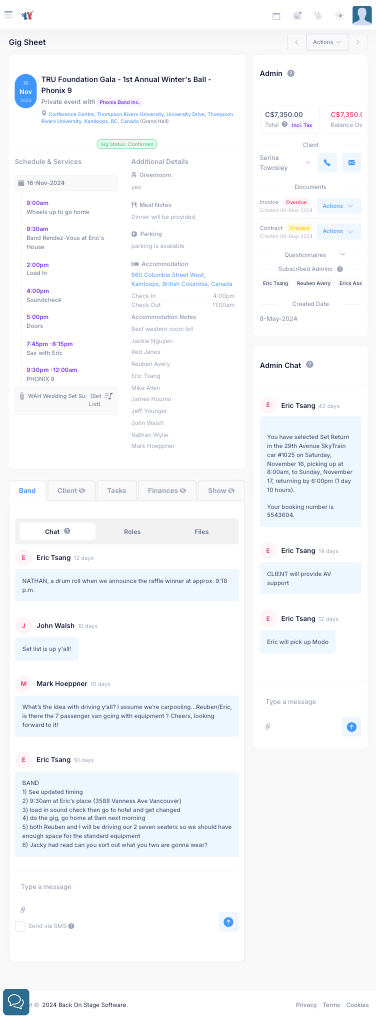
This is where a band management software platform can be more valuable than another spreadsheet.
A booking should carry its own documents, payment history, messages, and notes. That way, if someone asks what happened six months later, you’re not searching through three inboxes and a group text called “Gig Stuff.”
Invoice before or at the gig, not weeks afterward
Many bands treat invoicing as an administrative task to complete after the music is finished.
That creates a dangerous gap.
By the time you send the invoice, the venue may already be dealing with:
- A cash-flow shortage
- A new owner
- A closed bank account
- A cancelled event
- A landlord dispute
- A stack of unpaid vendors
Send the invoice with the contract. Request the deposit at the same time. Then send a balance reminder well before the performance.
If the remaining fee is due at the gig, make that expectation visible and easy to pay. Online invoices reduce the friction that often turns “I’ll send it tomorrow” into three weeks of chasing.
Use one system to make the professional process the easy process
This is one reason I built Back On Stage.
When I was running my own nine-piece event band, I knew how to book musicians and put on a show. The exhausting part was everything around it: contracts, invoices, payment follow-up, musician communication, schedules, and trying to remember which version of a document was current.
At one point, I was playing around 70 gigs a year, exhausted and still struggling to make the business profitable.
The problem wasn’t that I needed more hustle. I needed a system that connected the entire gig lifecycle.
With Back On Stage, you can send the contract and deposit request together through a professional Client Portal. Clients can review and sign digital contracts, receive online invoices, and make payments without a long email thread.
You can also keep booking details, financial records, and communications connected to the gig.
That matters because the best app for musicians isn’t only the one that helps you find or fill a gig. It’s the one that helps you protect the money attached to the gig.

A simple pre-gig payment checklist
Before accepting another venue booking, check that you have:
- A named payer
- A signed contract
- A deposit received
- A clear final payment date
- Cancellation and non-payment terms
- An invoice trail
- Written confirmation of any changes
- A plan to collect the balance before or at the event
None of this guarantees a venue will stay open. Businesses can still fail. Checks can still bounce. A new owner may still refuse to take on old obligations.
But clear terms and organized records can put you in a much stronger position than a band relying on a verbal promise.
If a venue closes, you may still need legal advice about whether to file a claim, pursue small claims, respond to foreclosure proceedings, or submit a proof of claim in a bankruptcy case. Act quickly when significant money is involved, and keep every document.
Most importantly, stop thinking of contracts and deposits as annoying paperwork.
They’re part of the performance.
You protect the sound with a good PA. You protect the band with a solid roster. You protect the date with a contract and deposit.
And you protect the fee by making payment part of the booking process from day one.
Start a free trial of Back On Stage and build a gig workflow that helps you spend less time chasing money after the show.
Sources: Bradenton Herald reporting on bands owed money by Motorworks Brewing.