

Back On Stage vs. monday.com: A Blank Board vs. A Booking System
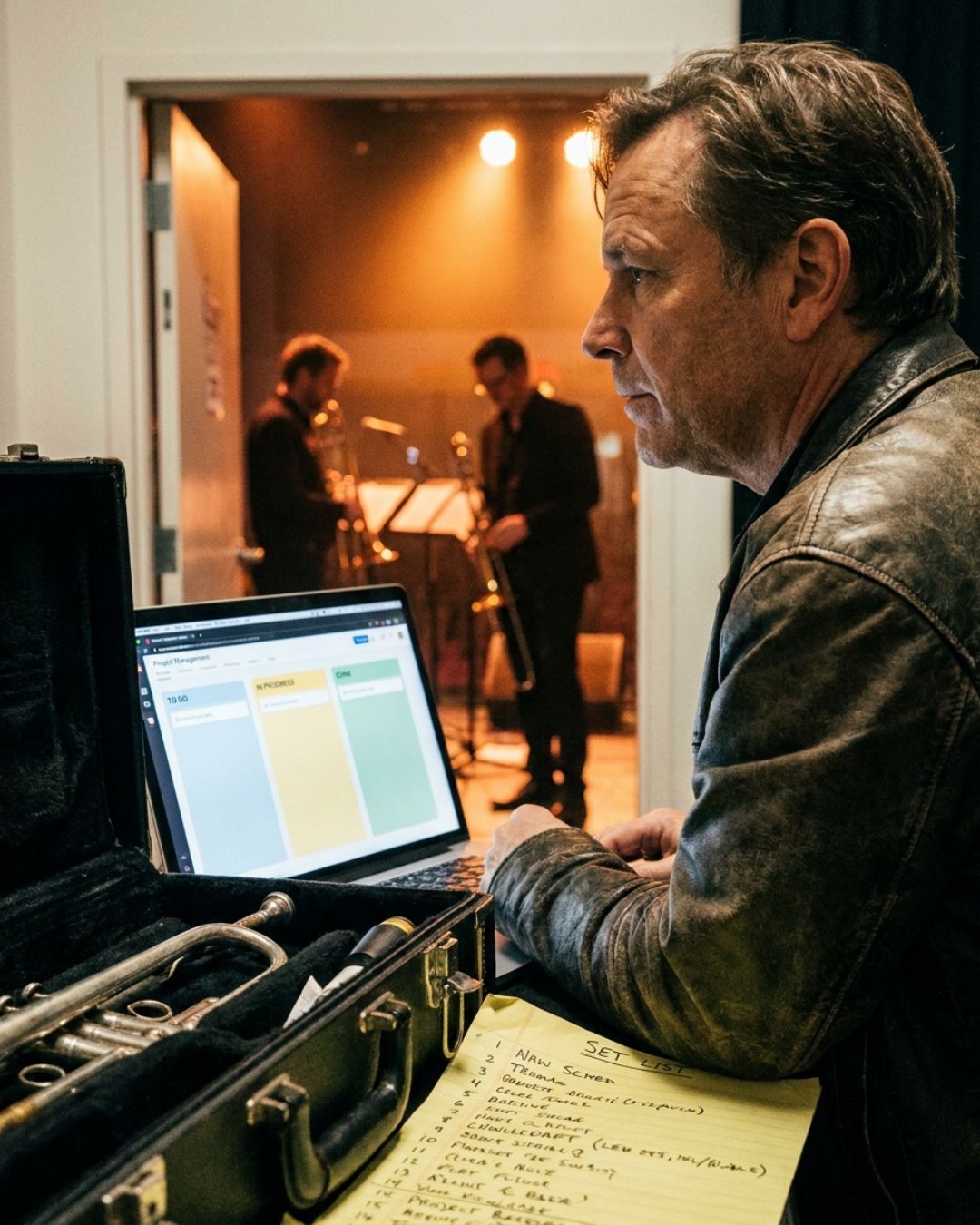
The board is not the problem. The fact that you have to build the band business inside it is.
Last reviewed September 2026. monday.com pricing read directly from monday.com/pricing on 1 September 2026. Back On Stage pricing read from backonstageapp.com the same day.
The short version
monday.com is a genuinely good piece of software. Thousands of teams run real businesses on it and they are not making a mistake.
It just does not know what a gig is.
monday.com hands you a blank board and a very good set of tools for building whatever you want on top of it. Back On Stage hands you a system that already knows a booking has a load-in time, a client, a deposit, a set list, four musicians on different rates, and a payout due after the last note.
That difference is not about which product is better. It is about who does the building.
Who each one is actually for
monday.com is for teams whose work has no standard shape. A marketing department, an agency, a product team. Every one of those runs differently, so a flexible board that you configure yourself is exactly right.
Back On Stage is for bandleaders and event musicians. Every booking in this business has close to the same shape. Enquiry, quote, contract, deposit, staffing, set list, gig, payout, final balance. That shape barely changes between a wedding in Vancouver and a corporate gala in Chicago, which is why it can be built once and shipped rather than assembled by every customer separately.
If your work has no standard shape, the flexibility is worth the setup. If it does, the setup is just unpaid work.
“We were using monday.com, Active Campaign, Dubsado, Google Calendar... paying for a bunch of tools. If you're not really thinking smart... you're gonna have to raise your rate so high that you're cut out of the local competition.”
Mike Zabrin, Funktastic Productions, Chicago wedding and event bandThat quote is on the Back On Stage homepage and it is the honest reason this page exists. Mike was not failing at monday.com. He was paying for four tools because no single one of them covered a band, and the cost of that stack was starting to show up in what he had to charge.
Feature comparison
| What a band actually needs | monday.com | Back On Stage |
|---|---|---|
| Booking record with load-in, soundcheck, doors, attire, parking, meals, accommodation | Build it yourself as custom columns on a board | Built in, on every booking |
| Client lead form embedded on your website that populates the booking | Forms exist and can feed a board, but the mapping to a gig is yours to design | Built in, with automatic acknowledgement and follow-up |
| Client contract with e-signature that pre-fills from the booking | Not native. Needs an integration or a separate contract tool | Built in, with data tokens that fill each contract from the gig details |
| Client invoice, deposit, online payment and tipping | Not native. Needs an integration or a separate invoicing tool | Built in |
| Offering a role to musicians in call order until someone accepts | Not native. Automations can notify people, but the call-order-until-filled logic is yours to build | Auto-Book, in the order you set |
| Warning you when a musician is already booked on another of your gigs that day | Not native | A conflict flag shown before you send the offer. It does not block you, it tells you |
| Filling a last-minute hole by asking every player at once, first yes wins | Not native | Shotgun Book |
| Set lists attached to a specific service, with keys, BPM, vocalist assignments and charts | Not native | Built in, with a repertoire library behind it |
| Paying musicians after the gig and generating their invoices automatically | Not native | Auto-Pay and automatic musician invoices |
| A free login for every musician showing their gigs, charts and payment status | Every person who needs to see a board is a paid seat | Unlimited musicians and crew at no extra cost on every plan |
| Running several act names or brands off one shared roster | Possible, but you design the whole model | Multi-company management on the Agency plan |
| General project boards, sprints, docs, dashboards for non-gig work | Excellent, and far more capable than Back On Stage | Not the point of the product |
Pricing, and the part that catches bands out
monday.com charges per seat. Read from monday.com/pricing on 1 September 2026: a free tier for up to 2 seats, then Basic at $9 per seat per month, Standard at $12, and Pro at $19, all billed annually, with Enterprise priced on request.
Those are reasonable numbers for an office. They behave differently for a band, because a band's headcount is the whole point. A nine-piece with a sound tech and a second admin is twelve people. On Standard that is $144 a month before you have added a single dep, and every sub you bring in for one Saturday is either another seat or another person working from a screenshot.
Back On Stage is priced per company, not per person. Read from backonstageapp.com the same day: Starter at $19 a month, Pro at $40 a month and Agency at $63 a month, all billed annually. Admin seats are included per plan (1, 3 and 5 respectively) with more available, and every plan includes unlimited musicians and crew at no extra cost.
| monday.com | Back On Stage | |
|---|---|---|
| Pricing model | Per seat | Per company |
| Entry price | $9 per seat per month (Basic, annual) | $19 per month (Starter, annual) |
| Cost of adding your fifth musician | Another seat | $0 |
| Cost of adding a dep for one gig | Another seat, or they work from a screenshot | $0 |
| What you still need to buy alongside it | Contracts, invoicing and payments, typically | Nothing for the gig lifecycle |
We are not claiming monday.com is expensive. We are pointing out that its pricing model rewards small teams and a band is the opposite of a small team.
The setup problem nobody prices in
The real cost of a general work OS is not the subscription. It is that somebody has to build the band business inside it, and then keep maintaining it as the business changes.
That work has three things wrong with it, and none of them are about discipline. It is nobody's job, because every other task in a band has an owner and this one lives in the gap between everybody's actual jobs. It has no deadline, because a gig has a date and a board configuration does not. And nobody is waiting on it. The client wants the contract. The drummer wants the address. Nobody on earth is chasing you to finish your automation recipes.
So the one piece of work that would make everything else faster is the only piece with no external pressure behind it. Half-built boards are the normal outcome, not the exception.
“I used to manually check 35 invoices, inputting every single amount into direct deposit. I can't imagine that anymore. It used to take me 3 hours to get everything set and scheduled for a gig. Now it takes me 15 to 30 minutes.”
Nikki Green, talent manager, Liquid Blue, San Diego. 277 hours saved last year.When monday.com is the right answer
We would rather be useful than win every comparison, so here is the honest list.
- Your work is not mostly gigs. If bookings are one part of a wider operation with production, staffing, marketing campaigns and product work all running in parallel, a general work OS earns its place.
- You need deep custom reporting and dashboards across many kinds of work. monday.com is much stronger here.
- You already built it and it works. If your boards run your season without you thinking about them, do not tear that up because a comparison page told you to. A system that works is worth more than a better one you have not set up.
- You have someone whose job is operations. If there is a person with the time and the inclination to own the build, the flexibility becomes an advantage rather than a tax.
When Back On Stage is the right answer
- Most of what you do is bookings, and they all have roughly the same shape.
- You are the person doing the admin, and you would rather it was already built.
- Your headcount changes constantly and you do not want to think about seats.
- You are paying for two or three tools that each do one part of a gig.
- You run more than one act or brand off one roster and need them on one calendar.
What Back On Stage does not do
It is not a general project manager. There are no sprints, no product roadmaps, no generic dashboards for arbitrary work. It does not build your website. If you want a tool that can model anything, this is not it, and monday.com genuinely is.
Back On Stage does one industry properly. Over $25M in real gig income has moved through it, across 10,000+ musicians and 8,000+ gigs booked.
Try it against your own next booking
The fastest way to settle this is not a feature table. Take your next real gig and run it end to end through Back On Stage. Enquiry, quote, contract, deposit, staffing, set list, payout. One booking, all the way through. You will hit every gap in the order you actually need it fixed, and you will finish, because there is a real client on the other end with a real date.
Start a 30-day free trial. No card needed to look around, and there is a 90-day money-back guarantee behind it.