

One Roster, Six Band Names: How Multi-Brand Event Bands Actually Work (And Where They Break)

I spend a lot of time reading wedding band listings. Not for fun, exactly. It is how I find bandleaders to talk to.
And after a few months of it, I noticed something that changed how I think about this business.
A large share of the acts at the very top are not one band.
You click a listing for what looks like a five-star party band. You get to the website and there are six band names on it. A soul band. A jazz combo for cocktail hour. A string quartet for the ceremony. A stripped-down duo for the smaller rooms. Different logos, different Instagram accounts, different reels, different showreel videos.
Same office. Very often, largely the same players.
That is not a trick and it is not padding. It is one of the smartest structures in this business, and if you run one act and you are wondering why the top of your local market seems to be everywhere at once, this is usually why.
Why the multi-brand model works
Here is the thing that makes it work, and it is a marketing insight rather than a musical one.
A client does not want “a band that does everything.” They want the right band for their room.
Somebody planning a 60-person garden ceremony is not looking for a twelve-piece show band that also does acoustic. They are looking for an acoustic duo. If your one website says “we can be a duo, a trio, a five-piece or a twelve-piece,” you have made the client do the work of imagining which version they are buying, and imagination is not a strong sales tool.
So instead of arguing with that, these operators built a brand for each room and let the client pick the one that already looks like their wedding.
The practical wins stack up fast:
- Each brand can be marketed on its own terms. Its own name, its own photos, its own price point, its own directory listing.
- You occupy more of the search results. Three brands on a venue's preferred vendor list is three chances, not one.
- You can say yes to more dates. Two brands can work the same Saturday if the personnel do not collide.
- You can serve budgets you would otherwise decline. The duo takes the gig that could never afford the show band, and it is still your revenue.
- Your bench gets more work. More configurations means more calls for the players you want to keep loyal.
One bench of great players, sold several different ways. It is a good model. We ended up running a version of it ourselves.
The part nobody puts on the website
The bench is the easy half.

The bottleneck in a multi-brand operation is almost never the players. It is the one person holding all the calendars.
The hard half is that six brands means six sets of enquiries, six quotes, six contracts, six deposits and six payout runs, all drawing from one pool of humans. And every one of those humans has their own career running alongside yours. Your first-call trumpet player is also somebody else's first-call trumpet player.
The moment two of your own brands want the same player on the same Saturday, the structure that was making you money starts costing you a client.
And notice how that failure actually arrives. It is not dramatic. The client who booked the trio has no idea the party band exists. The client who booked the party band has never heard of the trio. Neither of them did anything wrong, and neither did you. You are simply the only person on earth who can see both of those bookings at once, and you saw them a week apart.
For a long time, the thing holding all of that together in our business was one person's memory. Mine. And a system made of one person works beautifully right up until that person wants a weekend off, or gets sick on the morning of a wedding, or wants to hand a booking to somebody else without a forty-minute phone call first.
The real ceiling on this model
It is worth being blunt about this, because it gets diagnosed wrong constantly.
The ceiling on a multi-brand operation is not demand, and it is not talent. It is how many moving pieces one head can hold at once.
Demand is usually fine. If you built four brands that each look right to a different kind of client, the enquiries come. Talent is usually fine too, because the whole point of the model is that the players are already good and already yours.
What runs out is coordination capacity. And it does not run out linearly. Two brands is roughly twice the admin of one. Four brands is not four times, it is more, because now you also have to track the interactions between them. Every extra act adds a new set of collisions with every act you already had.
That is the shape where this either compounds or breaks. And which one it does comes down to whether the coordination lives in a system or in a person.
What actually fixes it
The fix is not fewer brands. Fewer brands means less revenue, and you built the extra brands for good reasons.
The fix is getting all of them onto one calendar that can see the conflict before the client does.
Concretely, four things:
- One calendar, all brands. Not one calendar per act. If two acts can never see each other's dates, you are the integration layer, and you are the part that fails.
- One roster, with rates attached. The same player might be $350 on the duo and $500 on the show band. That should be a property of the booking, not something you recalculate on a Sunday.
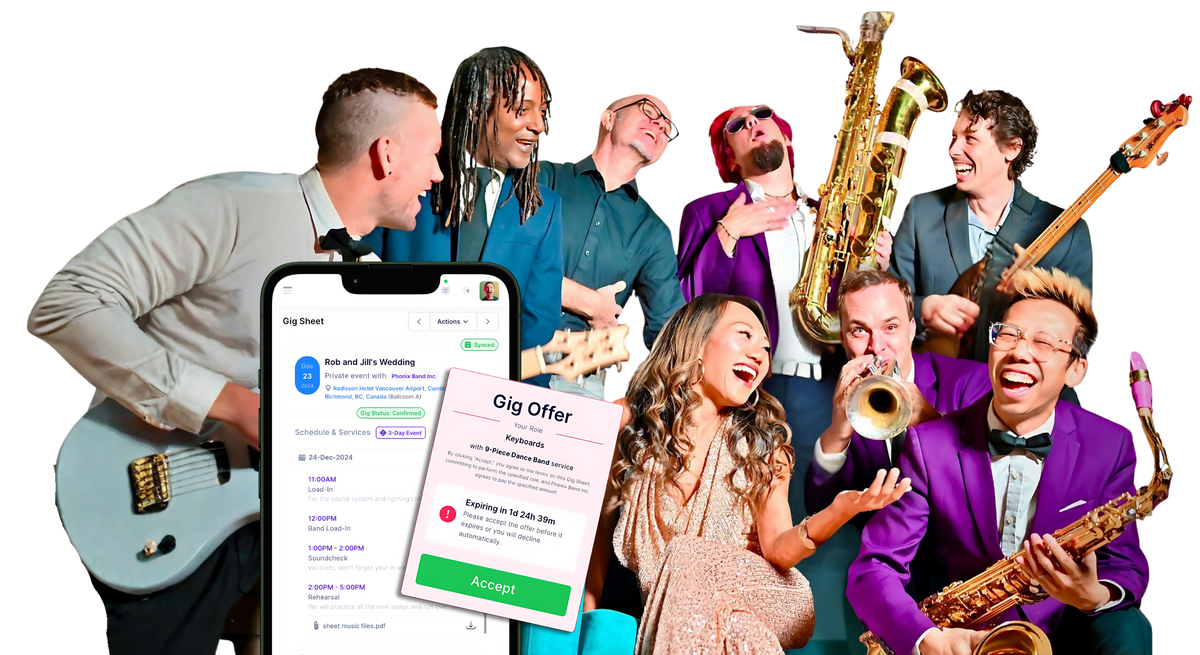
- A conflict warning before you send an offer, not after. In Back On Stage, when you go to fill a role, anyone already booked on another of your gigs that day carries a conflict flag right there in the list. It does not block you, and that is deliberate. Sometimes the same player really can do an early ceremony and a late reception. The point is that it becomes a decision you are making rather than something you find out about on the Thursday.
- Offers that chase themselves. Auto-Book works down your call list in the order you set, so filling a chair is not fifteen text messages and a mental note. And when somebody drops out six days before the gig, Shotgun Book asks every player on the list at once and gives it to the first yes.
If you are running several brands as genuinely separate businesses rather than as acts under one banner, Back On Stage's Agency plan handles multiple companies from one login, so you are not signing out of one brand to look at another.
See it running
This ten-minute walkthrough covers the whole booking lifecycle, including the roster and the offer flow. No slides, no signup.
“We used to have 50 gigs per year. Now we have over 200. This would not be possible without Back On Stage.”
Seth Sealfon, owner, Uptown Groove, New York wedding and event band. 1,543 hours saved last year.If you only run one act right now
Two things worth taking from this.
First, the operators above you in the listings are probably not better musicians than you. They found a structure that lets them sell to more kinds of client without hiring more kinds of musician. That structure is available to you.
Second, and more important: do not add the second brand until the first one runs without living in your head. A second act built on top of a memory-based system does not double your revenue. It doubles the number of things that can go wrong on a Saturday, and it puts them all in the same place.
Get one act genuinely systematised. Then the second one is mostly a website.
Try it against your own next booking
The honest way to test any of this is not a feature list. Take your next real gig and run it end to end. Enquiry, quote, contract, deposit, staffing, set list, payout. One booking, all the way through. You will hit every gap in the order you actually need it fixed, and you will finish, because there is a real client on the other end with a real date.
Back On Stage has now handled over $25M in real gig income for working bands, across 10,000+ musicians and 8,000+ gigs booked. Start a 30-day free trial.
Related reading
- You Don't Need Better Band Software. You Never Finished Setting Up the One You Have.
- Is Your Band Too Small for Band Management Software? An Honest Answer
- The Best Shared Calendar App For Event Bands
- 5 Steps to Automate Your Band Schedule and Payroll
Published September 2026.