


The Coordinator Tax: The Hidden Cost of Running a Band (And How to Stop Paying It)
Are you spending more time coordinating your band than actually playing in it?
If you're booking gigs, chasing musician availability, sending contracts, following up on unpaid invoices, building setlists, organizing travel, and managing payroll, you're not imagining the exhaustion. You're carrying what I call the coordinator tax.
The good news is that your band may be growing. More bookings, bigger lineups, better clients, and higher fees are all positive signs.
The hard truth is that growth also creates more invisible work. And if that work stays in your head, your inbox, your texts, and a dozen disconnected apps, the business can slowly drain the joy out of the music.
I know because I nearly quit my own band over it.
What is the coordinator tax?
The coordinator tax is the unpaid time and mental energy you spend keeping people, information, and money moving.
It includes the work that has to happen before everyone else can do their job:
- Asking musicians if they're available
- Chasing people who haven't replied
- Confirming call times and dress codes
- Sending contracts and invoices
- Following up on late payments
- Building and distributing setlists
- Finding last-minute substitutes
- Explaining the same gig details multiple times
- Checking whether everyone received the right music
- Calculating payouts after the show
None of this appears on stage. Clients don't see most of it. Your musicians may only notice it when something goes wrong.
But you feel every minute.
The broader business world often refers to this as the coordination tax, the time spent aligning people and work instead of doing the core work itself. Front's research on the coordination tax describes how coordination overhead can consume a surprising amount of a team's capacity.
For bandleaders, the cost is even more personal. Your core work is supposed to be performing, leading, creating, and building relationships. Instead, you're often acting as the booking agent, operations manager, accounts receivable department, payroll coordinator, music librarian, and customer support team.
All before soundcheck.
Bands don't die from bad music. They die from invisible work.
Most bands don't fall apart because the musicians suddenly forget how to play.
They struggle because the person holding everything together becomes exhausted.
At first, taking care of the admin can feel manageable. You have a few gigs, a small roster, and enough time to keep the details in your head.
Then the business gets busier.
One booking becomes five. Five musicians become fifteen. A simple wedding becomes a corporate event with travel, accommodation, multiple sets, special requests, and a detailed production schedule.
The music is still great. But the systems haven't kept up.
That creates a dangerous pattern:
- You become the only person who knows what is happening.
- Everyone comes to you for answers.
- You spend more time answering questions than building systems.
- Small tasks pile up between gigs.
- You start resenting the band you worked so hard to build.
The problem isn't that you're not organized enough. The problem is that the business depends on your memory and availability.
The five jobs hiding inside every gig
A gig is never just a gig. It usually contains several separate projects.
1. Booking and client management
Before the band arrives at the venue, someone has to manage:
- The initial inquiry
- The quote
- The hold and confirmation
- Event details
- Contract signatures
- Deposit and final payment
- Follow-up communication
If these details live across email threads, spreadsheets, and notes, you're constantly reconstructing the status of the booking.
That is where mistakes happen. A date gets missed. A deposit is forgotten. A client doesn't receive the contract. A promising lead goes cold because you didn't have time to follow up.
2. Musician scheduling
Filling a roster can become a full-time job, especially for event bands with rotating lineups.
You send one message. Then another. Then a reminder. Then you start contacting substitutes because nobody answered clearly.
A band booking app should help you see availability, send offers in a consistent order, and track who has accepted. It shouldn't require you to manually remember which musician is next on the list.
3. Event logistics
Someone needs to collect and share:
- Venue address
- Parking instructions
- Load-in times
- Soundcheck details
- Stage plots
- Dress code
- Meal information
- Hotel and travel details
- Client preferences
- Special announcements
When every musician can access the current information themselves, you stop functioning as a human search engine.
4. Payroll and financial administration
Getting everyone paid is one of the most important parts of running a professional band.
It is also one of the easiest tasks to delay when you're tired after a busy weekend.
Late payouts damage trust. Manual calculations create errors. Multiple payment methods make it difficult to understand the actual profitability of each gig.
Your team deserves clear, reliable payment processes. You deserve a system that doesn't require rebuilding the numbers from scratch after every performance.
5. Setlists and repertoire
The wrong chart, missing reference track, or outdated arrangement can create stress right before a show.
Your music library should be available to the whole team, with the right files attached to the right songs and roles. Otherwise, you become the person everyone calls when they can't find the second verse of a tune.

How to stop paying the coordinator tax
You don't need to fix everything at once. Start by making the work visible, repeatable, and shareable.
1. Put every gig in one place
The first step is creating one source of truth for each booking.
That means keeping the following together:
- Client contact details
- Event schedule
- Venue information
- Contract
- Invoice
- Payment status
- Musician roster
- Setlist
- Files and notes
- Tasks and deadlines
When you have to check six different apps to understand one gig, you're paying a software coordination tax on top of the bandleader tax.
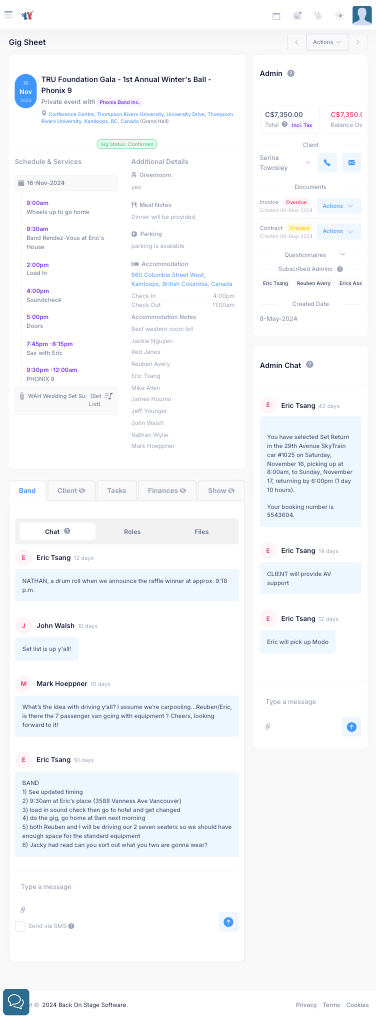
The goal of band management software like Back On Stage is to connect these pieces around the booking itself. You shouldn't have to remember where a piece of information lives. It should live where your team expects to find it.
2. Make the work visible to the whole team
Your musicians shouldn't need to ask you for information that could be available in their account.
Give the team access to:
- Confirmed gig dates
- Call times
- Venue details
- Assigned songs
- Reference recordings
- Event notes
- Payment information
This doesn't mean giving everyone access to sensitive business information. It means creating appropriate access so each person can see what they need without creating more work for you.
Visibility is one of the simplest ways to reduce interruptions.
3. Systemize confirmations and follow-ups
If you send the same message more than twice, it probably deserves a template.
Create repeatable workflows for:
- New lead responses
- Booking follow-ups
- Musician offers
- Confirmation reminders
- Client questionnaires
- Contract delivery
- Invoice reminders
- Post-gig payment notifications
The goal isn't to make your communication feel robotic. It's to stop wasting creative energy rewriting the same email at 11:47 p.m.
A good system keeps the process consistent while still leaving room for personal communication when it matters.
4. Build your gig checklist once
Every booking has recurring tasks. Write them down.
Your checklist might include:
- Confirm client details
- Send contract
- Send invoice
- Confirm lineup
- Collect event questionnaire
- Share travel details
- Publish setlist
- Confirm sound requirements
- Process musician payouts
- Request client feedback
Once you've created the checklist, turn it into a reusable template. That way, each new gig starts with a reliable process instead of a blank screen.
5. Stop doing unpaid labor for free
This is the uncomfortable one.
Many bandleaders price the performance but absorb the administration. You charge for the gig, then donate hours of booking, coordination, payment processing, and customer service.
That work has value.
You don't necessarily need to add an obvious “admin fee” to every invoice. But you should understand your real cost per gig and price accordingly.
Track your time for one month:
- How many hours go into each booking?
- How much time do you spend chasing availability?
- How long does payroll take?
- How many hours disappear into client follow-up?
- What does one missed payment or double-booking cost you?
Then calculate your effective hourly rate.
If you're earning a strong performance fee but making minimum wage for the business work around it, something needs to change.
The best musician apps reduce mental load, not just clicks
When you're looking at apps for musicians or searching for the best musician apps, it's easy to focus on feature lists.
But the more important question is:
Does this tool reduce the number of things you personally have to remember?
A useful system should help you:
- Keep booking details connected
- Reduce back-and-forth communication
- Give musicians self-serve access
- Create contracts and invoices from existing information
- Manage team payouts
- Store setlists and files centrally
- Follow up with leads consistently
- See what is complete and what still needs attention
That is the difference between adding another app and building an operating system for your band.

Your band needs systems before it needs more hustle
You can keep growing through effort for a while.
You can answer every text, maintain every spreadsheet, and remember every musician's availability. But eventually, the work becomes too large for one person's memory.
That doesn't mean you have to become less personal or less involved. It means the business needs a structure that supports the people inside it.
Back On Stage was created from that exact problem. As Reuben's story explains, the platform grew out of the experience of running a busy event band while managing bookings, clients, billing, and a large team.
The objective isn't to remove the human side of your band. It is to remove the repetitive work that keeps you away from it.
Start with one gig. Put the details in one place. Write down the recurring tasks. Give your team access to the information they need. Then measure how many hours you get back.
Your band doesn't need you to carry everything.
It needs you leading from the stage, not burning out behind the scenes.