


Why Your Invoice Payment Terms Don't Work (And What Actually Gets You Paid on Time)
What happens when you write “payment due within 14 days” on your invoice, then the venue tells you they’ll pay whenever their internal process allows?
You’ve already played the gig. You showed up, performed professionally, packed out your gear, and sent the invoice. Surely the payment terms printed on that invoice should count.
Here’s the uncomfortable truth: an invoice usually records what you’re owed. It doesn’t create new terms after the work is finished.
That’s exactly what happened in a pain-point report shared with Eva.
A solo musician working the care homes circuit stated 14-day payment terms on his invoice. He played the gig, sent the invoice, and later started chasing the payment.
That’s when a venue representative named Fiona explained that the venue’s new-vendor process paid in 28 days, plus another 7 to 10 days after the vendor setup was completed.
None of that had been explained upfront.
The result? He was facing the possibility of receiving no payment before Christmas.
The general consensus from other musicians was blunt: payment terms added to an invoice after delivery are effectively unenforceable if the client never agreed to them beforehand.
You may still be entitled to payment for the gig. But you may not be able to force the client to follow a due date, late fee, or interest charge that you introduced after performing.
So, what should you do instead?
Understand what an invoice can and can’t do
An invoice is a formal request for payment. It creates a paper trail and tells the client:
- What service you provided
- How much they owe you
- Where to send the money
- Which booking the payment relates to
- When you are requesting payment
That’s all useful.
But the invoice generally doesn’t allow you to unilaterally change the deal.
If you agreed to play for $1,000 but never discussed when payment would be made, printing “due within 14 days” on the invoice doesn’t necessarily make that deadline part of your contract.
The same applies to:
- Late payment fees
- Interest charges
- Collection costs
- Cancellation charges
- Deposits
- Shorter payment windows than the client’s normal process
These terms are much stronger when they’re agreed as part of the original booking.
As Capital Law explains, payment terms printed on an invoice may not be enforceable if they weren’t included in the original agreement or accepted through an established course of dealing.
The exact rules depend on where you live, so this isn’t legal advice. But the practical lesson is simple:
Don’t wait until after the gig to negotiate how you’ll get paid.
1. Lock payment terms in at the booking stage
Payment terms belong in your quote, booking confirmation, or performance agreement.
Not in the “notes” section of an invoice you send two weeks after the show.
Before you accept the booking, confirm:
- Total performance fee
- Deposit amount and due date
- Remaining balance
- Payment due date
- Payment method
- Who is responsible for taxes or processing fees
- Any travel, accommodation, meal, or equipment costs
- Cancellation terms
- Late payment terms, where legally allowed
You don’t need to make this complicated. A clear sentence can prevent a lot of awkward emails later.
For example:
The total performance fee is $1,000. A 50% deposit is due upon signing. The remaining balance of $500 is due within 14 calendar days after the performance date.
The important part is that the client sees this before the gig and has an opportunity to accept it.
If the venue responds, “Our payment process is 28 days,” you now have useful information. You can decide whether that works for you, adjust your price, or walk away before spending time preparing for the show.
2. Get a signed contract before load-in
A handshake, text message, or verbal promise may feel sufficient when you’re dealing with a friendly venue.
Until something changes.
The client contact leaves. The venue changes ownership. Accounts payable introduces a new process. The person who booked you says, “That’s not my department.”
Suddenly, everyone remembers the booking differently.
A signed contract gives both sides a shared reference point. It should clearly identify:
- The artist, band, or company
- The client or purchasing organization
- Venue address
- Performance date and times
- Number of sets and performance length
- Fee and deposit
- Balance due date
- Cancellation policy
- Technical requirements
- Travel and accommodation responsibilities
- Signatures from both parties
Your contract should be signed before you load in, not after the final encore.

You can use the Back On Stage performance contract guide to review the essential sections. If your bookings involve significant money or unusual legal terms, have a qualified lawyer review your contract for your jurisdiction.
Ask for a deposit when it makes sense
A deposit does more than improve cash flow.
It confirms that the client is serious, gives you working capital for preparation, and reduces the amount left at risk if something goes wrong.
Many event bands request a deposit of 25% to 50% of the total fee. The right amount depends on your market, the type of client, and the amount of preparation involved.
Whatever you choose, write it down and agree to it before accepting the date.
3. Create the invoice from the contract
Your invoice and contract should tell the same story.
If your contract says the balance is due seven days before the event, your invoice shouldn’t say “due on receipt.”
If your contract says the client pays by bank transfer, the invoice shouldn’t suddenly request PayPal.
If the contract says the total is $2,500, the invoice shouldn’t contain a typo that says $2,050.
Contradictions create room for delay and confusion.
The cleanest process is:
- Enter the booking details once.
- Use those details to generate the contract.
- Get the contract signed.
- Generate the invoice from the same booking record.
- Apply the deposit and show the remaining balance.
- Send the invoice with the agreed due date.
- Track whether it’s paid.

A professional invoice still matters. It makes payment easier, keeps your records organized, and helps the client’s accounts team process the charge.
But remember the distinction:
The contract establishes the obligation. The invoice documents and requests payment.
For more practical guidance, see this band and musician invoice template guide.
4. Remind clients before chasing feels awkward
Most musicians don’t enjoy chasing money.
You may worry about sounding difficult, especially when you want to work with the venue again. So you wait. Then you wait a little longer. Before you know it, the invoice is 30 days overdue and the follow-up email feels much more uncomfortable than it needed to be.
The solution is to make reminders part of your normal process.
A simple reminder schedule could look like this:
- At booking: Send the contract and deposit request.
- Seven days before the gig: Confirm the booking and outstanding balance.
- One day before the gig: Confirm payment logistics and final details.
- On the invoice due date: Send a friendly payment reminder.
- Three days overdue: Ask whether the client needs anything from you to process payment.
- Seven days overdue: Send a firmer written follow-up referencing the contract.
Keep the tone neutral and professional.
Hi Fiona, just checking in on invoice #104 for the performance on December 8. According to our signed agreement, the remaining balance was due on December 22. Could you confirm the expected payment date?
That message is much easier to send when the due date was agreed in advance.
5. Treat unclear venues as a warning sign
A venue doesn’t have to accept your preferred payment terms.
They may have a legitimate accounts payable process. They may pay every vendor on 30-day terms. They may require setup in a procurement system before they can issue payment.
That’s fine, as long as they tell you before you commit.
Be cautious when a venue:
- Refuses to discuss payment timing
- Says, “We’ll figure it out later”
- Won’t sign a basic agreement
- Won’t confirm who approves invoices
- Introduces new vendor requirements after the gig
- Avoids giving you a clear accounts payable contact
- Says your payment terms are irrelevant because they’re printed on the invoice
You can ask directly:
Before I confirm the date, could you please explain your vendor setup process, payment schedule, and any forms you need from me?
If the answer is 28 days plus 7 to 10 days for processing, you can price and plan accordingly.
The problem isn’t necessarily long payment terms. The problem is surprise payment terms.
Use a simple payment clause
Here’s a starting point you can adapt with appropriate legal advice:
The total fee for the performance is $. A deposit of $ is due upon signing this agreement. The remaining balance of $____ is due by ____ [specific date or clear trigger]. Payment will be made by ____. Any late payment charges will apply only where permitted by applicable law and agreed in this contract.
Avoid vague language such as:
- “Payment upon receipt”
- “Net 14,” if the client doesn’t understand what that means
- “Payment as agreed”
- “Late fees may apply”
- “Standard terms apply,” without attaching those terms
A due date should be easy for both sides to understand.
Make the process part of your band management system
The best musician apps don’t just help you store a calendar. They help you create repeatable systems around the work you’re already doing.
This is where a band booking app or band management software can make a real difference.
For example, Back On Stage lets you keep booking details in one place, then use those details to generate contracts and invoices. Your client can review and sign electronically, pay online, and access the relevant booking information through the client portal.
That means your payment terms are part of the booking process from the beginning, rather than something added as an afterthought.
You can also use scheduled reminders and booking tasks so you’re not relying on memory after a busy weekend of gigs.
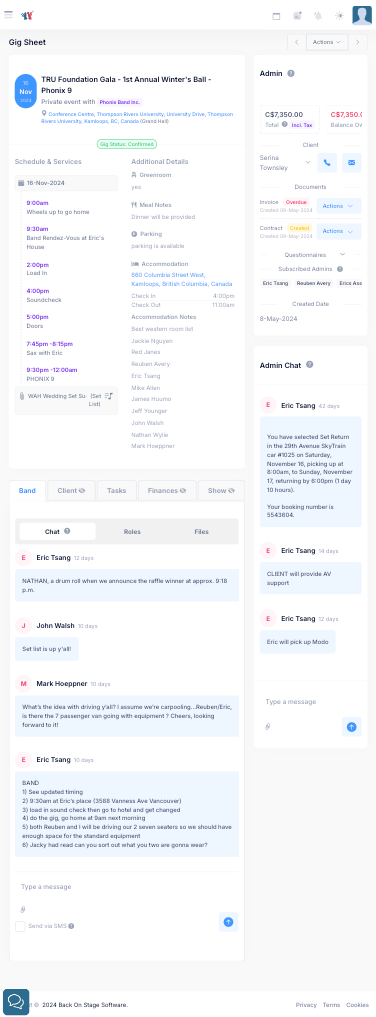
The goal isn’t to replace good communication. It’s to remove the avoidable admin that causes missed details, inconsistent terms, and late follow-ups.
Your pre-gig payment checklist
Before you accept the next booking, confirm:
- The fee is written down
- The deposit is agreed
- The balance due date is clear
- The payment method is confirmed
- The client’s vendor process is understood
- Cancellation terms are included
- Both parties have signed the contract
- The invoice matches the contract
- Payment reminders are scheduled
- You know who to contact if payment is late
An invoice can help you request payment.
But it shouldn’t be the first time your client hears when payment is due.
Agree the terms before the show, get them signed, and build your invoice from that agreement. That’s how you protect your time, your cash flow, and your working relationship with the venue.
Start your 30-day free trial of Back On Stage and see how contracts, invoices, payments, and gig details can live in one system.