


The Real Cost of a No-Show Musician (And How to Never Stress About One Again)
What would happen if one of your musicians stopped replying and didn’t show up for tomorrow’s gig?
If you’re a bandleader, you’ve probably already thought about it. Maybe you’ve even had to make frantic calls from a hotel lobby, venue loading dock, or soundcheck line while trying to find a last-minute replacement.
Most of the time, live music businesses run on trust. Your musicians show up, clients pay on time, and the show goes great. But when one person disappears, the cost can be much bigger than one empty spot on stage.
The good news is that you can reduce the risk dramatically with better contracts, clearer confirmations, and the right band management software.
A no-show costs more than the musician’s fee
Let’s say you’ve booked a four-piece wedding band for $1,800.
One musician doesn’t arrive. They aren’t answering texts. The client is asking what’s going on. The rest of the band is standing around waiting for instructions.
Your first thought might be, “I need to find a replacement.”
That’s only the beginning.
The real cost may include:
- An emergency replacement fee
- Extra travel or accommodation
- Overtime for sound engineers and crew
- Rehearsal or arrangement time
- Discounts or refunds for the client
- Lost trust with the event planner
- Hours spent documenting the situation and chasing the musician
- Stress for every other person involved
A last-minute replacement can easily cost more than the original musician’s rate. If the replacement needs to travel, learn new material, or cover a critical role like drums, bass, or lead vocals, the price rises quickly.
And if you can’t replace them, the impact can be much worse.
The client may receive a reduced performance. The event schedule may need to change. In the worst cases, the band may have to cancel part or all of the performance.
That $1,800 booking can suddenly create $3,000 to $5,000 in total exposure, depending on the event, the replacement cost, and the make-good you offer the client.
That’s an illustrative example, not a fixed industry average. But the point is simple: a no-show is a business risk, not just a scheduling inconvenience.
Why manual scheduling creates no-show problems
Most bandleaders don’t have a reliability problem because they’re careless. They have one because their scheduling process is held together with text threads, spreadsheets, memory, and crossed fingers.
You might send a message like:
“Hey, are you free for this one?”
Then you wait.
Maybe the musician says yes. Maybe they forget. Maybe they thought the gig was tentative. Maybe they saw the message while driving and never replied.
Then you send another message. And another.
Meanwhile, the booking is still not fully confirmed.
This creates a few common problems:
- You don’t know who has actually committed
- Musicians may not have all the gig details
- You can’t easily see who declined or never responded
- You have no clear order for contacting backup players
- You may confirm a client before your roster is secure
- You’re forced to remember every conversation yourself
That last one is the killer.
When your business grows, you can’t personally monitor every response from every musician for every gig. You need a system that keeps moving, even when you’re performing, driving, sleeping, or trying to have one normal evening with your family.
Build a direct-confirmation workflow
The strongest way to reduce no-shows is to move from informal availability checks to a direct-confirmation workflow.
That means every musician receives:
- The date and location
- The role they’re being offered
- The agreed rate
- The relevant performance details
- A clear option to accept or decline
- A deadline for responding
Most importantly, the musician confirms the gig directly inside the system.
That creates a much cleaner process than asking for a vague “probably” over text.
It also gives you a record of what happened. You can see who accepted, who declined, and when each response occurred. If there’s ever a dispute, you’re not trying to reconstruct the booking from six different message threads.

How Auto-Book keeps your roster moving
Back On Stage’s Auto-Book feature is built for this exact problem.
You create a ranked call list for each role. For example:
- Preferred drummer
- Second-choice drummer
- Reliable emergency drummer
When you send the offer, Back On Stage contacts the musicians in order. If the first musician declines, the offer moves to the next person.
No phone tag. No manually copying gig details into three different messages. No trying to remember who said they might be available.
You can also set an expiry time for the offer, so an unanswered message doesn’t sit in limbo forever.
The workflow looks like this:
- Add the musicians you want for each role.
- Set the call order.
- Confirm rates and gig details.
- Send the offer.
- Let each musician accept or decline directly.
- Continue down the call list until the role is filled.
- Review the activity log to confirm what happened.
That final step matters. The activity log gives you a timestamped record of offers, declines, and acceptances.
So instead of wondering whether someone saw your text, you have a clear answer.
The difference between an offer and a confirmed booking
A musician saying “I think I can do it” is not the same as a confirmed booking.
You need to separate these stages:
1. Available
The musician appears to be free, but hasn’t accepted the gig.
2. Offered
You’ve sent the musician the actual booking details, including the role and rate.
3. Confirmed
The musician has directly accepted the offer.
4. Ready
The musician has access to the final schedule, music, notes, arrival information, and any assigned tasks.
This distinction helps you avoid one of the most expensive mistakes in band management: treating a soft yes like a firm commitment.
A good band booking app should make those stages visible. You shouldn’t have to rely on memory or scroll through an old group chat to find out who’s really booked.
Make the gig details impossible to miss
A musician may be reliable and still miss a gig because the information was scattered.
Maybe the call time was in an email. The parking details were in a text. The dress code was in a PDF. The setlist changed in a group chat. The venue address was copied incorrectly into someone’s calendar.
That’s how avoidable mistakes happen.
Once your roster is confirmed, keep the details in one central gig sheet. Back On Stage gives you a shared place for:
- Load-in and soundcheck times
- Venue address and parking notes
- Accommodation details
- Dress code
- Meal notes
- Client or event information
- Setlists and music files
- Tasks and internal communication
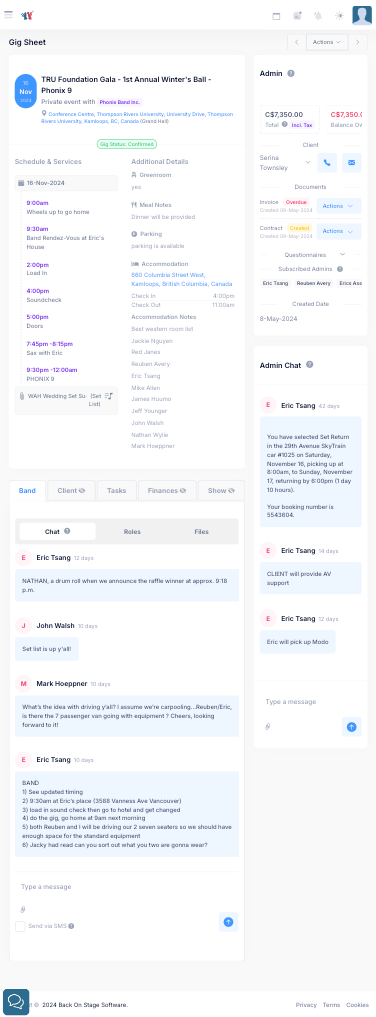
Musicians only need access to the information relevant to the gigs they’re booked for. You keep the client and financial details private, while your team gets the information they need to arrive prepared.
That clarity reduces the chance of confusion before the event and gives everyone one reliable source of truth.
Use contracts to protect the business
A scheduling system helps prevent no-shows. A clear contract helps protect you when something still goes wrong.
Your band performance contract should explain:
- What counts as a cancellation or no-show
- How much notice is required
- What fees apply to late cancellations
- Who is responsible for replacement costs
- What happens if illness or an emergency occurs
- How and when payments are made
The exact language should fit your business and location, so consider having your contract reviewed by a qualified professional.
You can also review Back On Stage’s resource on music performance contract templates and use the artist booking pricing guide to understand the real costs that need to be covered in your rates.
A contract won’t stop every musician from cancelling. It does make expectations clear before the gig is accepted.
Create a backup plan before you need one
Even with a strong system, life happens. Musicians get sick. Cars break down. Family emergencies come up.
The goal isn’t to pretend you can eliminate every possible problem. The goal is to make the next step obvious.
Create a backup structure for each important role:
- Your preferred musician
- Your second-choice musician
- A reliable emergency substitute
- A smaller arrangement that can still perform
- A DJ, acoustic duo, or other fallback option when appropriate
Store those preferences in your band management software so you don’t have to rebuild the plan every time a musician declines.
Tip: Don’t wait until the day before the gig to discover that your backup drummer has never seen your charts. Give backup musicians access to the right music library, reference recordings, and notes ahead of time.
Stop carrying the whole roster in your head
You didn’t start a band to become a full-time scheduling coordinator.
But when your booking process depends on memory, you end up doing exactly that. You’re tracking who is available, who owes you a reply, who needs the updated setlist, and who still hasn’t confirmed the call time.
That’s a lot of responsibility for one person.
Back On Stage was created by a bandleader who experienced that pressure firsthand. The platform brings musician scheduling, gig details, communication, contracts, invoices, payments, and setlists into one place.
According to Back On Stage, users have grossed more than $25 million through the platform, with more than 10,000 musicians using it.
The benefit isn’t just fewer messages.
It’s having a process you can trust.
A simple no-show prevention checklist
Before you confirm your next gig, make sure you can answer “yes” to these questions:
- Does every role have a ranked call list?
- Does every musician accept the actual gig offer directly?
- Is there a response deadline?
- Can you see who accepted and when?
- Are gig details stored in one central location?
- Does everyone have access to the correct music and setlist?
- Do your contracts include late-cancellation and no-show terms?
- Do you have at least one backup option for critical roles?
- Can you confirm the final roster without searching through text messages?
If you answered “no” to several of these, your current process may be creating unnecessary risk.
Take the stress out of musician scheduling
You can’t control every emergency.
You can control whether your booking process is clear, trackable, and ready to move when someone declines.
That’s the real value of a band booking app like Back On Stage. Auto-Book helps you fill roles in a defined order. Direct confirmations show you who has truly accepted. Shared gig sheets keep everyone informed. Contracts and records help protect your client relationships and your revenue.
The result is simple: fewer surprises, less phone tag, and more confidence that your band will be ready when the event begins.
Explore the Back On Stage features, see how the gig management platform works, or start with a 30-day free trial.
Your next gig should be about making the room sound great, not wondering who’s going to show up.