

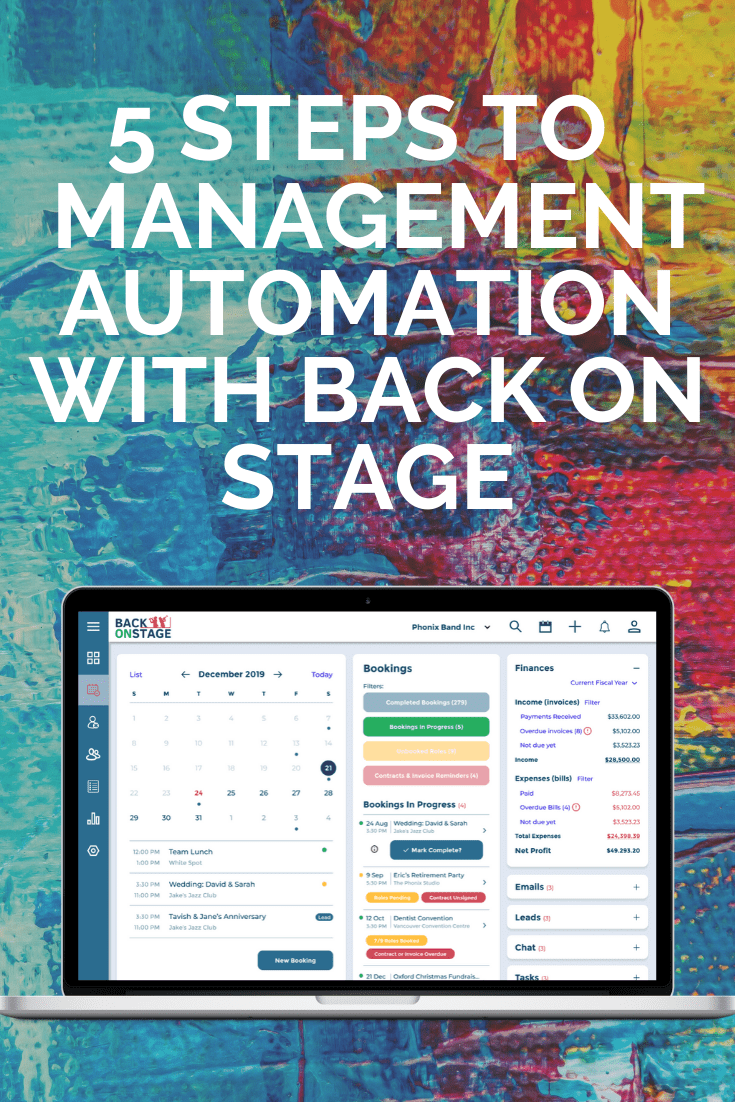
5 Steps to Music Artist Management Automation with Back On Stage

Playing live is a fantastic way to grow your fan base as a band or improve your music career as an artist. Your group can connect with your fans, attract new ones, and demonstrate your talents to the world.
However, lining up new gigs and managing all the details can take many hours of a bandleader's time each week.
Fortunately for bandleaders and music artist management pros, freedom has arrived in the form of the Back On Stage app. It rolls the best features of several separate apps into one interface, so the whole booking runs in one place instead of across a calendar, a spreadsheet, an inbox and a group chat.
How much time that actually saves depends on how you work now. Nikki Green, who manages talent for Liquid Blue in San Diego, put a real number on it: "It used to take me 3 hours to get everything set and scheduled for a gig. Now it takes me 15 to 30 minutes."
In this article, we'll show you how to automate your band's management in five steps. To follow along, start a 30-day free trial of Back On Stage.
Setting up your account only takes a couple of minutes. You enter the information for your organization, add band members, and assign each member their role or roles. You can add them manually or search for them in the database.
Once you have your account set up with your band roster, you're ready to start booking gigs.
Here are the five steps to automating your band and music artist management.
1) Create a Booking
Once you launch the Booking Creator, you can name the gig and manage everything from one screen, including:
- Booking Title
- Date and location of the event
- Client details
- Booking Status - In negotiations, Confirmed or Cancelled
- Schedule - Load in, Soundcheck, Doors, and End
Other information sections about the gig are:
- Attire
- Meal Notes
- Backline/Production
- Parking
- Notes - visible to everyone
- Admin Notes - visible to Admins only
- Guest list
- Accommodation Information
When you are finished adding the gig information, hit "Save" and go to the next screen.
A note about client and event details
Back On Stage automates the process of collecting client and event info by using lead forms, which you can embed on your band's website. When a client fills out their information on the form, it automatically populates here, saving you the trouble of typing it again.
Lead forms can also be configured to send automatic follow up emails to your clients so you don't forget to keep the conversation going.
Once you have negotiated with a client and they have decided to book you, Back On Stage enables you to create and send a client questionnaire so that you can easily collect the remaining gig details.
When a client fills out the questionnaire, all their updated info is injected into the booking automatically. No need to worry about processing the answers yourself and manually copying and pasting the data all over the place.
A note about Guest List
There is a built-in guest list feature for the nights you need one. It helps venue security identify who is on your list, and it prints on company letterhead with the show details and any notes you want to add.
A note about Accommodations
This feature helps everyone stay organized and on time.
Use this section to add the details of the band's stay, including location, check-in and check-out times, and notes. Anyone who has been assigned a role for that gig can view the information from their own login.
2) Add Services
Next, you can add all the services you will provide for that gig. These can be band performances, sound systems, travel fees and so on.
Service Profiles
When you add a new service to your band or music group, you will be prompted to provide details for the service profile, including:
- Service Title: for example "9-Piece Dance Band" or "Large Sound System & Tech"
- Description: this is what you want clients to see on their invoices
- Price: the typical price you charge for this service, in your chosen currency
- Charge Tax: select the applicable tax. If you don't charge tax, leave it blank. You can configure your own custom taxes in your company settings.
- Who do you hire for this service: list the staff or musician roles you usually book for this service and the amounts you typically pay. This speeds up your musician booking process later.
You can add as many services or performances as you need to each booking.
Add Services To Bookings
When adding a service to a booking, list them in chronological order so they show up logically on your contract, invoice and booking pages.
With each service, you can add the following details:
- Start Time
- End Time
- Notes (for musicians and staff)
- Set List
A Note About Set Lists
It has always been a headache keeping track of set lists and making sure every musician on a gig knows exactly which songs are being performed.
To build set lists, you first populate your band's repertoire library with all your material. Each song in your repertoire has an information card listing the:
- Title
- Lead vocalist name(s)
- Key
- BPM
- Original artist
- Bandleader notes
- Song length
- Audio files (band rehearsal, live audio and so on)
- Video links (for choreography and so on)
- File Attachments (sheet music, lyric sheets and so on)
Your repertoire library is accessible to musicians any time for their learning purposes.
When adding files such as sheet music, you can specify which roles can view it to reduce confusion. Every band member and any last-minute sub has access to the same music files, so there is no miscommunication.
Attach Set Lists To Bookings
Creating a set list from the songs in your music library takes only a few steps:
- Choose the songs from your master list
- Reorder: drag and drop to reorder
- Assign Vocalists: have multiple singers in your band? Decide who will sing each song
- Time Calculator & Notes: insert timing points or add performance notes like band breaks, solos or speeches
Once the set list is complete, you can attach it to a specific service within a booking. That way, the set list for your wedding ceremony solo guitar can be different from your 9-piece dance band set, even though both are part of the same booking.
Set lists show your musicians the song details they need and let them toggle information on or off depending on their individual needs. You can make adjustments on the fly, and if everyone is using internet-enabled devices they get the updates right away.
3) Invoice and Contract
Once you've captured the gig and client's details and added your services, creating a contract or invoice takes only a few clicks. The app pre-fills most of the information for you. Customize your own contract templates for different packages to streamline your booking and billing process.
Automatic Invoice Creator
The invoice creator uses the information from the service profiles you selected in step 2 to pre-fill your invoice line items, calculate tax and calculate a total. It also uses customizations you preset to determine whether you charge a deposit, how much it will be and when it is due. You just choose whether to add a discount or adjust any service descriptions or prices.
Automatic Contract Creator
Gone are the days of painfully editing your contract template to match each new booking. Back On Stage lets you insert data "tokens" into your contract template so it can create a tailored contract for each gig. It automatically injects data like client name, service details and deposit amount right into your sentences and paragraphs, so you don't have to worry about missing anything.
Open it up, review it and send it.
eSignature and Online Payment
Clients can sign your contract digitally and pay your invoice online. There is even an option for them to add a tip.
BONUS: the app has a built-in email service which lets you send and receive client communications all in one place, so you and your team are always up to date. At every step of the booking and billing process you can create your own email templates for standard replies, which saves a lot of time on future bookings.
4) Hire (book) Your Musicians and Staff
Band and music artist management is unusual in that each gig requires a specific set of musicians at specific rates. Chasing everyone for availability and following up again and again is a thankless job, and it is the part Back On Stage takes off your plate.
Choose the roles (or musicians) required for the booking. Roles can be instrument or staff positions like "Trumpet", "Drums" or "Sound Tech". Here again, you can create templates to save details like which roles are needed, how much each will be paid and your specific call order for each role.
The Auto-Book feature is where this really shows its value. You can list multiple musicians per role, and the app will contact each musician in the order you choose. If musician #1 does not respond or declines, the app contacts musician #2, and so on until your band is complete for that gig. Back On Stage also flags a conflict for you if someone you are offering a date to is already booked on another gig in your company, so you see it before you send rather than after.
For example, The Phonix has a 9, 7 and 5-piece version depending on the gig. The bandleader set up three separate templates with the appropriate musicians, which saves hours on every future booking.
A bandleader can see which musicians have confirmed, who has been contacted and who is pending.
Paying your musicians
After the gig, a bandleader can pay each musician online or log any other payment method used.
There is also an Auto-Pay option that pays musicians after a gig based on preset timing you specify in your company settings. Tick the Auto-Pay checkbox next to a musician's name and their payment is sent automatically after the gig.
Back On Stage also generates musician invoices automatically and emails a copy to the musician, the bandleader and anyone else the bandleader specifies. You and your musicians can log in any time to download invoices or check payment status, so "hey, did you pay me for that gig yet?" stops being a text you have to answer from memory.
5) Promotion
This page is where you enter the show information, including the description, ticket pricing and the ticket link. Use it as the central place you come back to for all your event promo info.
This information also feeds your Show Feed Widget, which you configure in your company settings. It is an embeddable widget for your band's website that shows an up-to-date list of all your upcoming public shows without you having to update it by hand.
You can also create and schedule social media posts for your shows from inside Back On Stage.
The Only Band and Music Artist Management Automation Tool You'll Ever Need
Now that you've got everything and everyone in the system, you can manage your next gig from one place. The tedious administrative work, writing contracts, billing, and organizing your band members, stops being something you hold in your head.
Related reading
- Is Your Band Too Small for Band Management Software? An Honest Answer
- You Don't Need Better Band Software. You Never Finished Setting Up the One You Have.
- How to Choose the Best Band Management Software in 2026 (Compared)
- The Best Shared Calendar App For Event Bands
Back On Stage has now handled over $25M in real gig income for working bands. If you want to see how it would fit what you already do, start a 30-day free trial.
Last reviewed August 2026.